Why Your Organization Needs a Queue Management System Right Now
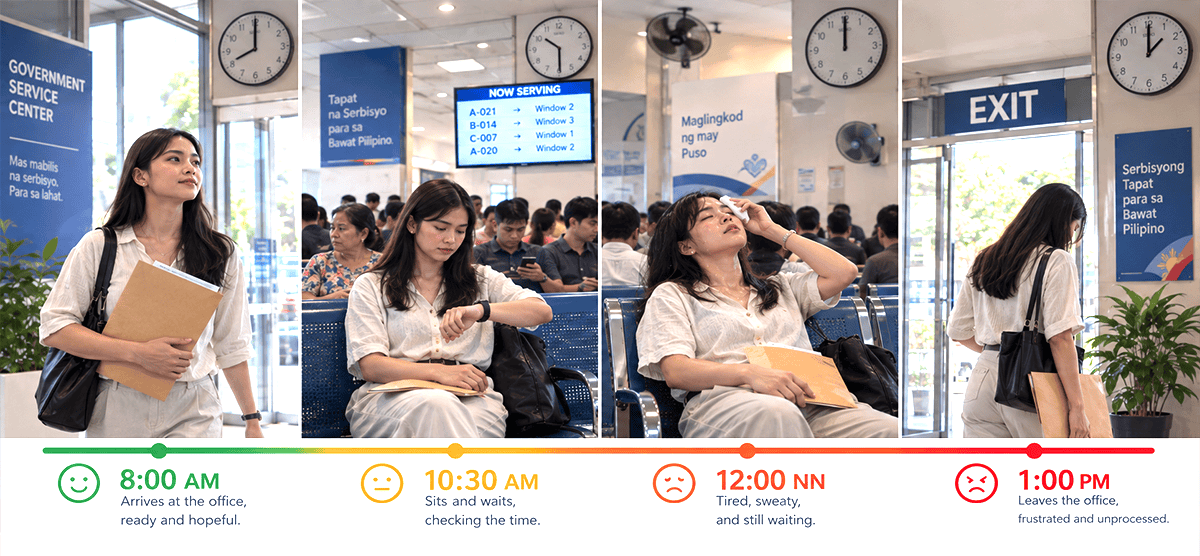
Picture this: a citizen arrives at your government office at 8:00 AM — determined, ready, documents in hand. By 10:30 AM, they are still waiting. By noon, they have not been served. By 1:00 PM, they leave frustrated, empty-handed, and with a story to tell about your agency.
This is not a hypothetical scenario. It is happening right now, every day, in government offices and service centers across the Philippines. And it is costing your organization far more than you realize not just in citizen dissatisfaction, but in staff productivity, operational efficiency, legal compliance, and institutional reputation.
The Queue Management System (QMS) is no longer a luxury upgrade for large, well-funded agencies. It is the baseline infrastructure requirement for any organization that is serious about delivering quality service in the 21st century. This article makes the case boldly, clearly, and with evidence for why your organization needs one now.
"Every minute a citizen spends waiting in your queue is a minute they spend forming an opinion about your organization. Make that opinion count."
— Cosmotech Philippines, Service Delivery Solutions Division
The Real Cost of Unmanaged Queues
Most organizations think about queue problems in terms of citizen inconvenience. That is only the surface. The true cost of unmanaged queues runs deep into your operations, your workforce, and your budget.
❌ Without a QMS
- Citizens wait 2–4 hours for simple transactions
- Staff overwhelmed, errors increase under pressure
- No data on service volumes or peak times
- Complaints pile up with no tracking mechanism
- Favoritism and queue-jumping create conflict
- Management flying blind on performance metrics
- Citizens leave and return another day — repeat visits
- Anti-Red Tape compliance difficult to prove
✅ With QMS (QMaster)
- Citizens served in 15–30 minutes on average
- Staff work at sustainable, organized pace
- Real-time dashboard of all service windows
- Citizen feedback captured automatically at counter
- Fair, transparent, first-come-first-served system
- Live reports on average wait time, service time, volumes
- First-visit resolution rates dramatically improved
- RA 11032 compliance documented automatically
The numbers speak clearly: an unmanaged queue is not just an inconvenience, it is an operational failure with real financial and reputational consequences. Staff burnout increases. Citizen trust erodes. And the cycle repeats, day after day, until something changes.
 The Anti-Red Tape Risk
Under Republic Act 11032 (Ease of Doing Business Act), government agencies are required to streamline frontline services and eliminate unnecessary waiting. ARTA is actively monitoring compliance and agencies that cannot demonstrate efficient service delivery face serious regulatory and reputational consequences.
Why Manual Queue Methods Always Fail
Many organizations still rely on manual queue systems, paper-based numbering, verbal calling of clients, or informal “please wait on the bench” arrangements. These methods feel familiar and low-cost. But they are fundamentally broken, and here’s why:
No Visibility — You Cannot Manage What You Cannot See
Manual queues provide zero real-time data. How many people are waiting right now? How long has the longest-waiting client been here? Which service window is overloaded and which is idle? With a paper stub system, no one knows, not the supervisor, not the branch manager, not the agency head.
Without visibility, you cannot make real-time adjustments. You cannot redirect staff. You cannot open additional service windows before a crisis point is reached. You are permanently reactive, responding to problems after they have already frustrated your citizens.
No Accountability — When Anything Goes Wrong, Nobody Knows Why
How long did Client #47 wait before being served? How many clients left without being served on Tuesday afternoon? Which service window has the slowest average transaction time? With manual queue management, none of these questions can be answered with data.
This lack of accountability makes it impossible to identify and address performance problems. Underperforming windows continue underperforming. Bottlenecks go unaddressed. And when a citizen complaint escalates, your agency has no data to either refute it or learn from it.
No Fairness — Queue Integrity Breaks Down Without a System
Manual queues are inherently vulnerable to queue-jumping, favoritism, and corruption. When a client “knows someone” or can negotiate their way to the front, the entire system loses legitimacy. Other clients notice. Trust erodes. And the social contract between your organization and the public it serves breaks down.
A digital Queue Management System enforces strict first-come-first-served integrity automatically with a numbered ticket, a digital display, and a complete audit trail. There is no room for manipulation, and every client can see exactly where they are in the queue at all times.
No Scalability — Manual Systems Collapse Under Volume
On a slow Monday morning, manual queue management may be manageable. On the last day before a major deadline when hundreds of clients arrive simultaneously, it becomes a disaster. There is no mechanism to handle surge volume, prioritize urgent cases, route clients to the right service window, or communicate expected wait times.
A QMS scales automatically with demand. It intelligently distributes clients across available service windows, provides real-time wait time estimates, and flags when surge capacity protocols need to be activated all without requiring supervisors to manually orchestrate the chaos.
What Cosmotech’s QMaster Delivers
QMaster is Cosmotech’s purpose-built Queue Management System, designed specifically for the operational realities of Philippine government agencies and enterprise service centers. It is not a generic queuing tool adapted for local use, it is built from the ground up to handle the specific service delivery challenges that Filipino organizations face.
 Smart Kiosk Ticketing
Self-service kiosks allow clients to select their transaction type, receive a numbered ticket, and get an estimated wait time, all without staff involvement. Available in Filipino and English.
Large-format display screens show the current ticket being served at each window, the next numbers to be called, and real-time estimated wait times visible from anywhere in the waiting area.
Supervisors and branch managers see a live dashboard showing all service windows, current queue lengths, average wait times, and staff performance enabling instant operational decisions.
After each transaction, clients rate their experience in real time via a touchscreen feedback kiosk. Satisfaction scores are captured per service window, per staff member, and per transaction type.
Automated daily, weekly, and monthly reports covering service volumes, wait times, peak hours, and staff performance, ready for ARTA compliance reporting and management review.
Clients receive SMS notifications when their number is approaching allowing them to wait outside, run an errand, or sit comfortably rather than anxiously watching a screen from a crowded waiting area.
Automatically identifies and routes senior citizens, PWDs, pregnant women, and other priority clients to dedicated service lanes, ensuring compliance with the Senior Citizens Act and Magna Carta for PWDs.
For organizations with multiple service offices, QMaster provides centralized visibility across all branches from a single management console, compare performance, benchmark branches, and manage resources across locations.
QMaster’s priority lane management ensures automatic compliance with the Expanded Senior Citizens Act (RA 9994), Magna Carta for Persons with Disability (RA 7277), and the Solo Parents Welfare Act (RA 8972) with automatic routing and audit logs to prove compliance during inspections.
Who Needs a Queue Management System?
The short answer: any organization where clients, citizens, or customers arrive in person and wait to be served. If your facility has a waiting area, you need a QMS. More specifically:
If your organization appears on this list, then every day without a QMS is a day your citizens are waiting unnecessarily, your staff are working less efficiently than they could, and your agency is accumulating compliance risk.
Direct and Indirect Cost Savings
- Staff efficiency gains: Organized queuing allows staff to maintain a consistent, sustainable work pace — reducing overtime costs and burnout-related turnover
- Repeat visit reduction: When clients are served correctly the first time in a reasonable time frame, they do not need to return reducing service volume and staff workload
- Reduced supervision overhead: Automated queue management requires less active supervision, freeing senior staff for higher-value activities
- Compliance cost avoidance: Documented compliance with ARTA and priority service laws prevents costly penalties and reputational damage
- Resource optimization: Real-time data enables smarter staffing decisions, scheduling more service windows during peak hours, fewer during slow periods
Government agencies that implemented Cosmotech’s QMaster reported an average 40% reduction in citizen waiting time within the first 30 days of deployment — with some high-volume offices achieving up to 60% reduction during peak hours.
The Bottom Line: Stop Making Citizens Wait
The Filipino citizen does not owe your organization their patience. They come to your office with a legitimate need. They deserve to be served efficiently, fairly, and with dignity. Every hour they spend in an unmanaged queue is an hour your organization has failed them.
The technology to fix this is mature, proven, and available right now. Cosmotech’s QMaster has been deployed across hundreds of government agencies and service organizations nationwide delivering measurable improvements in waiting times, staff productivity, citizen satisfaction, and regulatory compliance.
The only question is how much longer your organization will wait before making the change. Because while you are waiting to decide, your citizens are already waiting and they are already forming their opinion of your organization based on that experience.
"The best time to implement a Queue Management System was the day you opened your doors to the public. The second best time is today."
— Cosmotech Philippines, QMaster Solutions Team
With over 31 years of experience and 3,000+ organizations served across the Philippines, Cosmotech is uniquely positioned to deploy QMaster in your facility quickly, efficiently, and with minimal disruption to your ongoing operations. Our implementation team handles everything, from hardware setup and software configuration to staff training and go-live support.
See QMaster in Action
Book a free demo and see how QMaster can transform your service
center’s waiting experience.